Monday, June 17, 2013

Fathers of the Animal Kingdom

By: Judi Stuart
Port Discover: Visitor Services Manager
Fathers of the Animal Kingdom
Sigmund Freud said, “I cannot think of any need in childhood as strong as the need for a father’s protection.”   Although they don’t get any recognition, there are some stellar examples of fathers who are doing a remarkable job of parenting in the animal world.

The seahorse would be at the top of anyone’s list of great animal fathers.  He is actually morphologically specialized to take care of the babies.  The female inserts the eggs into the male’s brood pouch where he keeps them for 10-30 days depending on the species.  The male’s belly swells as the 10-300 eggs mature.  The labor and delivery can take several hours and after the babies hide in the grasses, the daddy will return to the same female to mate again.
In the insect world, the giant water bug works hard to care for his young.  After mating, the female attaches approximately 150 eggs on the father’s back.  He does deep knee bends to aerate them, strokes them to keep them clean, and leaves the water to remove parasites.  When the eggs hatch, he kicks them off his back. 

While the female red fox stays in the den with her kits keeping them warm and fed, the father must hunt and provide her with food every four to six hours.  After three months, the father brings food for the kits and hides it beneath leaves and brush.  He teaches them to sniff and seek out the food, thus laying the groundwork for hunting in adult life.
A male sea catfish gives up eating while he carries eggs the size of marbles in his mouth.  For a month, he lives off his body fat and continues for another few weeks to feed his young as they grow. 

Some species of frogs and toads also carry eggs in their mouths and do not eat.  Some types embed the eggs under the skin on their backs or legs.  The pouched frog carries eggs similar to the way marsupials do.  
The arctic lumpsucker fish may not be beautiful, but he is devoted to overseeing the eggs that the female lays.  He attaches himself near his offspring with special suction cups on his body.  From there, he defends the eggs and attacks any predators who threaten them.

March of the Penguins, a popular movie produced in 2005, masterfully presents the family life of emperor penguins.  After an arduous walk to their mating grounds, the female lays the egg and gives it to the father to protect while she marches back to the sea to eat for two months to replenish her depleted nutrition.  The father holds the egg between his feet keeping it warm and safe from the harsh elements until it hatches.
Other animal species including the arowana, rhea, wolf, and marmoset have unique ways in which the males carry out their roles as father.  Mother Nature has fascinating ways of insuring the survival of every species. 

Tuesday, May 28, 2013

Science Myths

By: Judi Stuart
Port Discover - Visitor Services Manager

Science Myths

Who knows why we sometimes believe things that are false? Maybe we don’t like the truth. Maybe it’s easier to believe the myth. Maybe we’re unable to determine the truth. Maybe the story has been accepted so long that no one bothers to question it anymore.

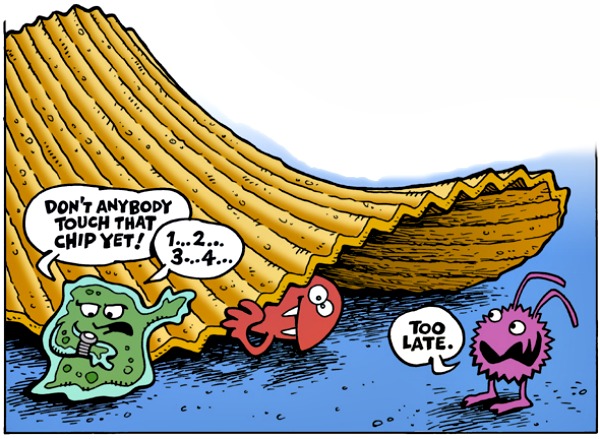
Science is filled with myths and commonly accepted untruths. Take the one called the “5 second rule.” We’re comfortable with that. It makes us feel better about picking-up something off the kitchen floor and eating it. The truth is that germs stick to things immediately. If there is salmonella present, which is frequently found in the kitchen, it will stick to the food immediately.

Another commonly accepted belief is that lightning doesn’t strike twice in the same place. Actually, it happens quite frequently. The Empire State Building is struck an average of twenty-five times per year. Tall targets are hit more often than others are.

It is somewhat startling to think that we only use ten percent of our brains. The fact is that we use all parts of our brain in some way or another. What we don’t use to its full capacity is our intellectual ability.

We have been told that brain cells don’t regenerate, but in 1998 scientists discovered that our learning and memory centers can do so. Recently stem cell research has discovered a way that embryonic stem cells can morph into brain cells.

Have you ever heard that a penny dropped from a tall building can reach a velocity that will enable it to kill someone that it hits on the ground? Have no fear. The size and aerodynamics of the penny will not allow such a tragedy.

Is a car the best place to be during a lightning storm because the rubber tires will protect you? In truth, it is the metal exterior of the car that will act as a conductor, passing the electrical charge to the ground.

We’ve all heard that sugar makes kids hyperactive. The truth is that scientists can find no evidence for that assumption. Of course, we know that there are links between sugar consumption and obesity.

It is a common myth that after we die our fingernails and hair continue to grow. Cells need a constant supply of fuel produced by the ingestion of food in order to grow. They also need blood being pumped to them by the heart.

If you think that bats are blind, you are mistaken. They do rely on other sense like hearing and smelling more than some animals, but they can see. Their advanced sound based system of echolocation allows them to hunt nearly invisible prey in the dark.

Parents and kids, hoping for better things to come for themselves, like the story about Albert Einstein’s having flunked math class. Records of his academic life show that he was actually a good student which contradicts the popular myth.
Now it’s up to you to believe it or not.

(Source: Discovery Channel website)

###

Sunday, May 5, 2013

Controlling the Enemy

By: Judi Stuart
Port Discover - Visitor Services Manager

Controlling the Enemy

What creature on earth is responsible for more human deaths than any other? Maybe you’re thinking about monstrous snakes, fierce alligators, tigers, elephants, or some other powerful predator.

You may be surprised to know that many scientists credit the mosquito as being one of the most dangerous animals on earth. By virtue of their ability to carry so many potentially deadly diseases, especially malaria, the mosquito has been a formidable enemy of humankind throughout history.

Some historians list malaria as one of the factors in the downfall of the Roman Empire. The settlement of Jamestown was devastated by fever carried by mosquitoes. During World War II 500,000 soldiers were infected, causing a significant health problem among the forces.

The term malaria comes from the Italian words for “bad air” so named because it occurred near swampy areas. Later it was discovered that a species of plasmodium carried by the insect was the cause of malaria.

In this area, we joke about the size of the Hatteras mosquitoes, but these relatively small creatures are the subject of much angst throughout the world. The only place where you could escape them on earth is Antarctica.

In the world of etymology, they are known as vector organisms, which means they are agents for transmitting an infectious pathogen into another living organism. There are 3,500 species, but not all of them carry disease such as malaria, yellow fever, dengue fever, West Nile virus, and eastern equine encephalitis virus (Triple E).

In 2010, the World Health Organization reported 219 million cases of malaria and 660,000 to 1.2 million deaths from the disease that now affects forty percent of the world. Although great strides have been made since 2000 in controlling malaria worldwide, underdeveloped countries are still devastated by its occurrence among children. One out of eight children in sub-Saharan Africa dies from disease before reaching age five.

Insecticides, repellents, and insecticidal bed nets are the main means of preventing the spread of the disease. When DDT could be used as a pesticide, control of the insect led to a drop in the disease. Efforts to develop a vaccine have not been successful, but work is continuing.

In areas of the world where the disease is still prevalent, economic growth is slow and the resulting poverty makes health care and prevention unavailable to most of the population. During the late nineteenth and early twentieth century the economic progress of the American South was affect by the same cycle of disease and poverty.

In the past decade, the distribution of long lasting insecticidal nets, improved diagnostic tests, and better treatment have reduced the deaths from malaria by more than fifty percent around the world. Costs of these measures have also declined making them more available.

Global foreign aid and scientific measures being taken in this area of disease control has had a huge effect in making the world a better place for all.
###
Related Posts Plugin for WordPress, Blogger...