Showing posts with label Holiday. Show all posts

Sunday, February 24, 2013

Master of Scientific Investigation

By: Judi Stuart
Port Discover - Visitor Services Manager

Master of Scientific Investigation

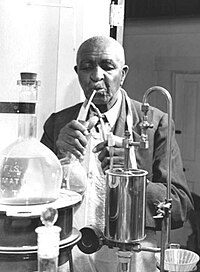
“Man cannot live by bread alone; he must have peanut butter.” What would we do without it? Dr. George Washington Carver, American scientist, botanist, educator, artist, and inventor discovered 325 products that could be made from the lowly peanut, which originally came from Africa.

Born a slave in Missouri, Carver persevered through many obstacles and became a well-educated and much admired contributor to the American way of life. His scientific discoveries dealing with plants had a significant impact on southern agriculture which continues today.

Peanuts, soybeans, and sweet potatoes were the primary objects of his study for several decades. He once said, “If you do the common things in life in an uncommon way, you will command the attention of the world.” And so, he did.

The products that he developed from the peanut included cream, buttermilk, instant coffee, face powder, printer’s ink, shampoo, dyes, soap and wood stain. Soon farmers were making more money from peanuts than they did from cotton or tobacco. It was nicknamed “goober” which came from its Congo language name, “nguba.”

Today, the uses of peanut butter itself include curing hiccups, removing gum from carpet, removing bug splatters from cars, fixing scratches on DVD’s and CD’s, removing gum from hair.

Carver’s work with sweet potatoes produced 118 products including flour, starch, tapioca, dyes, ink, and synthetic rubber. During World War I, sweet potato flour was mixed with wheat flour to make bread because wheat was in short supply.
Soybeans had been brought from China and were first planted in Georgia in 1765 and primarily used for livestock feed. Carver found through his experimentation that it was a good source of protein and oil. He told farmers to rotate peanuts, soybeans, and sweet potatoes. The result was a better cotton crop because the plants replaced essential nutrients in the soil.

Dr. Carver’s experimentation with soybeans resulted in the development of laminated plywood, particleboard, finger-jointed lumber; soy based wood adhesive, and carpet and upholstery products. Henry Ford collaborated with Carver to produce a plastic material that was then used in several parts of car manufacturing.

Currently, a process called transesterification removes the glycerin from the soybean and leaves soy biodiesel which is cleaner burning than petroleum based diesel, reduces particle emissions, is non-toxic, renewable, and environmentally friendly. Soy crayons, soy ink, soy lubricants, and soy hydraulic fluid are widely used.

Though Dr. Carver received lucrative offers from Ford and Thomas Edison, he stayed faithful to Tuskegee Institute for fifty years where he died in 1943. Congress declared January 5 as Dr. George Washington Carver Day in honor of his life achievements and contributions to society.

Dr. Carver’s impact on Albemarle agriculture is immeasurable. Today, all 100 counties of North Carolina grow soybeans, and Pasquotank is one of the top producers. Each year Elizabeth City hosts a Soybean Festival to share information about the useful plant.

(Source: Black Pioneers of Science and Invention by Louis Haber)
###

Sunday, December 30, 2012

Science News for 2012

By: Judi Stuart
Port Discover - Visitor Services Manager

Science News for 2012

Reflections, reviews, and resolutions parade before us during the week between Christmas and New Years. Deciding which scientific events of 2012 will have an impact on mankind would perplex most people.

Science News Magazine has decided on several most notable stories because they literally kept them up by breaking in the middle of the night. Their top twenty-five best stories list included “You Really Can Learn While You Sleep,” “Milky Way Will Bite the Dust,” “Earth’s New Neighbor Looks Familiar,” and “Bionic Women (and Men) Get Closer to Reality.”

New species are still being discovered on the planet. A monkey with a blue rear end and blonde mane, the world’s smallest fly, a sponge shaped like a harp, and a “cave robber” spider are among the 16,000 to 20,000 new species that will have been described by biologists during 2012.

Although scientists have described about 1.9 million species so far estimates predict 6.8 million more to be discovered. It may take another 400 years to accomplish this task at the current rate.

Having been hit with cuts to the space program NASA enjoyed the successful landing of its newest rover, Curiosity, on Mars. Enthusiastic space scientists and millions of fans watched the perfect landing online. Dubbed “Seven Minutes of Terror” for the space scientists, the remarkable touchdown was broadcast on the big screen in New York City’s Time Square. It seems we will never get over our fascination with attempting to find signs of life on the Red Planet.

Prosthetic science produced some of the most promising moments for mankind during the year. Cathy Hutchinson, paralyzed by a stroke, was able to control a robotic arm through the use of an implanted brain chip. Olympic athletes ran on high-tech carbon blades and a young man was able to climb Chicago’s Willis Tower with a thought-controlled limb. Sight in patients suffering macular degeneration may be helped in the near future by a prosthetic that will be placed in the back of the eye. It is already on the market in Europe.

A naturally occurring event presented a rare picture in the sky during June. Venus steadily passed across the surface of the sun allowing scientists to see more of Venus’ upper atmosphere and its gaseous clouds that have been such a mystery. The last time the planet crossed the sun was in 1882 and 1874 and the next time will be in 2117 and 2125.

Nicolle Rager Fuller
The biggest news in physics was unveiled by Joe Incandela of the University of California, Santa Barbara. Finally, the answer to decades of scientific questioning appeared in the form of the Higgs, a subatomic particle which will help explain why the universe looks the way it does.

While you and I are tucked in our beds and fast asleep, scientists of our world are constantly making discoveries. Read about more 2012 discoveries in “Science News Top 25” at www.sciencenews.org.
###

Sunday, December 16, 2012

Spirits Everywhere

By: Judi Stuart
Port Discover - Visitor Services Manager

SPIRITS EVERYWHERE

Mannheim Steamroller has created my favorite versions of Christmas music for the last twenty-five years. I always get some growling from Hubby when he gets his fill of it during the holidays. A couple of years ago he changed his tune when he heard Mannheim’s “Up Above the Northern Lights on Christmas Night.”

The piece is a hauntingly dramatic musical reflection of the astronomical phenomenon scientifically known as the aurora borealis (northern) or aurora australis (southern) which usually occurs near the two poles of the earth. One of his bucket list goals is to go to see the lights in all their glory.

Proclaiming that “magic fills the air” and “spirits are everywhere” the lyrics get in your mind and won’t leave you. You can see it and hear it on www.youtube.com with a video (see below) of the scientific wonder in action.

The lights have been observed since ancient times, but the earliest account is from Babylonian clay tablets during the time of King Nebuchadnezzar II in approximately 568 B.C.

The dancing curtains of magical colors have fascinated humans for thousands of years. Aristotle called them light torches, and Europeans of the Middle Ages thought that they were flaming heavenly castles or armies of warriors who had died in battle.

Children of Norway believed that the lights would swoop them up into the sky if they waved a napkin at them. Eskimos thought that the aurora was dancing animal spirits of deer, seals, and salmon. Inuit tribes thought that the spirits of the dead were playing football with a walrus skull across the sky.

Named after the Roman goddess of dawn, Aurora, and Boreas, the Greek name for north wind, the Northern Lights can appear as patches of light, streamers, arcs, or rays painted in colors of green, blue, violet, red, and yellow. On rare occasions, when solar storms are extremely violent, the lights can be seen much further south or north than the poles.

Solar winds from sun storms send charged particles to earth in the form of clouds of gas. Earth has a protective shield called the magnetosphere. When the particles collide with the magnetic field, they cause changes and generate currents which flow along the lines of magnetic force into the Polar region. When they run into oxygen and nitrogen atoms, they produce the dazzling aurora lights.

Auroras tend to be more spectacular during periods of high solar activity which cycles every eleven years. The activity has been known to damage our electrical power grid and satellite operations. The National Aeronautics and Space Administration (NASA) has sent satellites on several missions called FAST, POLAR, and IMAGE to observe the activity of the Northern Lights.
The best places to see the northern lights are closer to the poles such as Canada, Alaska, Greenland, and Antarctica. They happen all the time, but can only be seen with the naked eye at night.

As the song proclaims, “Christmas night...Let your dreams take flight.”
###

Sunday, December 2, 2012

A Season of Senses

By: Judi Stuart
Port Discover - Visitor Services Manager

A Season of Senses

Without silver bells, pumpkin pie, colored lights, snowflakes, candlelight, carols, children’s smiles, and other favorite things, the holidays just wouldn’t be the same. Humans are sensory focused creatures.

We have now entered the winter wonderland of sensory awareness. With its unique collection of experiences that delight our senses, the Christmas season can enhance the enjoyment of stimuli like no other during the year.

So much of our pleasure in life as human beings comes by way of our senses of touch, taste, smell, hearing, and seeing. Each holiday during the year has its own special set of foods, songs, scents, colors, and textures for us to experience. Every culture around the world has its own unique celebrations with their special sensory experiences.

Our senses bring us pleasure and sometimes pain. They are our radar for the world around us and give us impressions that affect our mood and our interaction with our surroundings. Each one of us has smells, sounds, sights, textures, and tastes that connect us to our own Christmas memories.

My father’s favorite carol was the “Little Drummer Boy” so the sound of that makes me think of him. My sister and I always got a new doll from Santa when we were young, and even now I can clearly remember the smell of the vinyl as I went to sleep. My own children say that it’s not Christmas without the smell of the sausage and egg casserole waking them up.

Spreading glistening, white angel hair all over the tree was my task as a child. Since it was made of fiberglass, the pain of it and the redness of my hands lasted for a couple of days. That’s not a good memory. Who can ever forget the story of “The Little Match Girl” and its tragic descriptive ending?

If you want to increase your enjoyment this season, try some techniques to focus your senses. Take the time to breathe deeply and notice all of the specials scents around you whether they’re food or the cold, crisp air of the outdoors. Stare at the night sky and notice the brightness of the stars and the moon. Enjoy the light displays all over the city. Listen to holiday music and try to hear the softer sounds. Find a new holiday food and learn its history and how to prepare it.

Act like a kid and touch everything. Think of all the descriptive words that are unique at Christmas. Most of all, encourage your children to do all of these things with you.

Take a long walk on a dirt road and maximize the use of your senses. Notice the small things in your world. Slow down. None of your senses work their best when you rush.

Many of the things that bring us the most pleasure during the holidays don’t cost a thing. If you focus on your sensory awareness this season, you will come closer to experiencing the real meaning of Christmas-love.
###

Sunday, November 18, 2012

Let’s Talk Turkey

By: Judi Stuart
Port Discover - Visitor Services Manager

Let’s Talk Turkey

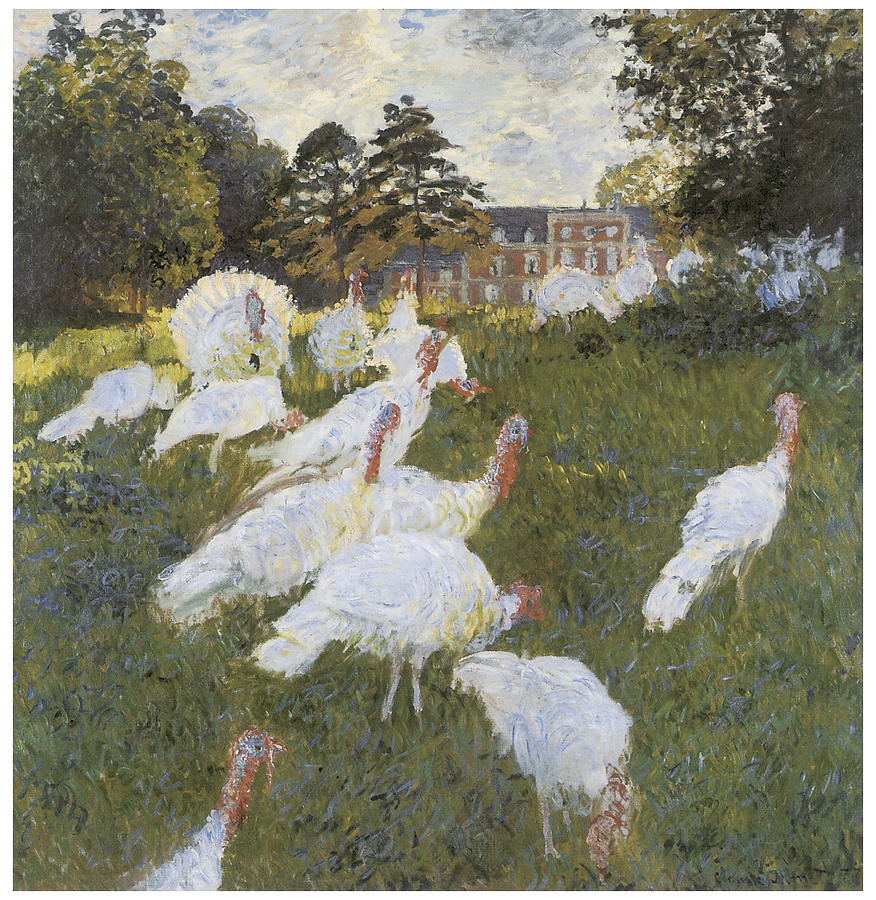
Turkeys Painting by Claude Monet
Perhaps no other bird has been given so much respect and disrespect as the Meleagris gallopavo or wild turkey. Benjamin Franklin called him a “bird of courage” and French impressionist Claude Monet painted him in a landscape in 1876. If someone calls you a “turkey,” it’s not a compliment. Since this famed character will be the center of attention in most of our homes next week, I think he deserves some understanding.

The species was well known to the Native Americans and the Aztecs long before the explorers of the New World discovered them. They were so desired by the Spanish explorers that their king ordered that each ship must bring some of the birds home with return voyages.

Mayans used turkey parts in religious ceremonies praying for rain or asking for healing or a good harvest. Native Americans believed that shamans could turn themselves into turkeys and then prowl around enemy villages without being recognized.
The European settlers replaced the boar and the goose with the turkey for festive meals and thus made it the legendary center of the Thanksgiving feast. The official day for the holiday was set by Franklin D. Roosevelt in 1939, although it had been unofficially celebrated for years.

With a wingspan of about six feet, wild turkeys can fly at 55 miles per hour and run at 25 miles per hour, but their modern domesticated cousins can’t fly at all because they have been bread to weigh twice as much. In the wild, turkeys like to sleep in trees and specifically prefer oak trees. Scientists have found that they have twenty distinct vocalizations which are recognized by other turkeys.

Some people have proclaimed that turkeys are so stupid that they will stare up at rain until they drown. Researcher Tom Savaged studied the phenomenon and discovered that they can have a genetic condition which causes them to cock their heads and look into the sky for 30 seconds or more which may have led to the misunderstanding of the animal’s behavior. They have also been observed to have certain social interactions which indicate intelligence.

Wild turkeys forage for acorns, insects, seeds, roots and wild berries to eat. Early settlers found that the birds liked to live near humans and were friendly and trusting and would walk right up to them and even seemed affectionate. A male can weigh up to 38 pounds and is called a Tom turkey or a gobbler.

Although they have no ears, turkeys still have a keen sense of hearing. Hunters can testify that their peripheral vision is astounding because with a turn of their head, they can see 270 degrees and sense movement a hundred yards away. They have a poor sense of smell but do have an excellent sense of taste.

Like many animals that are raised for food, the domestic turkey is mistreated and misunderstood. I think I’ll be a little more thankful for my bird this year.
###

Wednesday, March 28, 2012

Celebrate Earth Day

By: Judi Stuart
Port Discover - Visitor Services Manager

Celebrate Earth Day

Forty-two years ago, 20 million Americans, mostly from thousands of colleges and universities, united for the observation of the first Earth Day. Citizens turned their passion and energy from the anti-war protests of the sixties to a mounting national concern about the environment.

On April 22, 1970 the grassroots event marked the start of what is the modern environmental movement. Citizens were way ahead of the government officials, and the Democrats and the Republicans became united in their support of taking care of our natural resources.

Senator Gaylord Nelson of Wisconsin, recognizing the rising concern, had been laying the ground work for several years for a day of observation about environmental issues. Rachel Carson’s publication of the best seller Silent Spring in 1962 brought attention to the use of pesticides and their effect on birds and other wildlife.

Earth Day quickly became an annual event, and in 1990 it became a global movement in 141 countries and mobilized 200 million people. Across the world demonstrators railed against toxic dumps, oil spills, power plants, raw sewage, freeways, and the loss of wilderness areas and the extinction of wildlife.

The movement led to the creation of the Environmental Protection Agency (EPA), the passage of the Clean Air, Clean Water and Endangered Species Acts. Each decade has brought additional challenges, but the commitment remains strong.

More than one-third of all energy is used by people in their homes. Families throw away about 88 pounds of plastic every year. Aluminum cans and plastics take 500 years to break down. Cotton rags, and paper, and organic materials take six months to decompose.

“Knowledge is power,” wrote Sir Francis Bacon. If you’d like to pump-up your power for dealing with the environment, plan to attend the Port Discover Earth Day Festival on April 21.

Featuring demonstrations and information about all aspects of creating and living an environmentally friendly life, it will take place at Mariners’ Wharf from 10:00 am - 3:00 pm.

Hands-on science activities for all ages will focus on such topics as water quality and energy efficiency. Groups from the community will participate bringing information about organic gardening, composting, rain barrels, recycled crafts, energy conservation, recycling, nature crafts, just to name a few topics.

Gwen Bell, independent Shaklee distributor, Culligan Water, and Elizabeth City Parks and Recreation are supporting the event. Music will begin at 11:00 am with the Battle of the Bands, a local competition sponsored by the Youth Tobacco Prevention program of the Albemarle Health Services.

Taking care of planet Earth is a responsibility of every good citizen. As the population increases, the mandate becomes even more important to our survival. Knowledge of scientific principles regarding environmental issues will give us each the key to making a difference in our children’s world. See you at the festival!
###

Monday, December 19, 2011

"Not A Creature Was Stirring..."

By: Judi Stuart
Port Discover - Visitor Services Manager

"Not A Creature Was Stirring..."

“Twas the night before Christmas, and all through the house, not a creature was stirring, not even--- a squirrel, a snake, a spider, a grasshopper. Well, as we all know, the peace of Christmas can often be disturbed in unexpected ways.

Take the movie “Christmas Vacation.” Can anyone forget the scene when the squirrel jumps out of the Christmas tree and into Chevy Chase’s living room? Later in the movie a cat chews on an electrical wire and sets itself and the tree on fire. Is it slapstick comedy or reality?

One Christmas afternoon years ago, I was sipping my tea and enjoying a tranquil moment in my living room, when I was startled by something flying through the air. Before I could move, I was again surprised by a fluttering sound and a second object shooting from the Christmas tree. To my amazement, there were two grasshoppers staring at me from the carpet. The warmth of the house had convinced them that it was time to emerge from their home.

My sister had a similar experience when she got up one morning, after having decorated her tree, and found spiders crawling around the bottom of the tree. Every morning, she found the same invasion of the spiders going on. The tree was full of spider eggs. I still laugh at the thought of her jumping around the tree in her pajamas killing the spiders but refusing to take the tree down until Christmas night.

A family in Zebulon, NC recently discovered a corn snake in their newly erected artificial tree which had been stored in the garage. Their six year old discovered the foot long visitor when she was turning on the tree. Although the non-venomous snake won the hearts of the children, the mother wanted nothing to do with him. “Tinsel” as the kids named him now lives in the woods near their house.

It doesn’t seem to matter if the tree is real or fake, creatures will inhabit it. A little precaution is in order when bringing the tree into your house, although rarely would these accidental visitors be harmful to you or your home.

A vigorous shaking will likely loosen any inhabitants. Then inspect it visually for egg casings, etc. Aerosol inspect sprays are flammable and should not be sprayed on the Christmas tree. Most trees are free of invaders or the ones that are there are unnoticeable.

Pine bark adelgids are harmless and sedentary and do not leave the tree. Aphids are sometimes found, but they are usually host specific and will not feed on your houseplants. Sometimes certain bark beetles bore into the trunk of a tree, but they are not a threat because the wood in a home is too dry to attract them. Other creature such as mites, praying mantis, scale insects and spiders are other harmless insects which might be found on your tree.

Here’s hoping all of your holiday guests come with invitations!

###
Related Posts Plugin for WordPress, Blogger...