Sunday, March 10, 2013

Snow Today, Gone Tomorrow

By: Judi Stuart
Port Discover - Visitor Services Manager

SNOW TODAY, GONE TOMORROW

As I write this column, the “S” word is in the weather forecast, maybe. When I taught school, I always instructed my students to wear their pajamas wrong side out on the nights that snow was predicted to fall. Most teachers are as foolish as children are when it comes to the magical precipitation. A snow day off is like playing hooky with God’s permission.

Common adages about encouraging snow include placing a spoon under your pillow, leaving ice cubes on the porch, putting a white crayon in your freezer, shaking a snow globe while dancing, and flushing an ice cube down your toilet.

People in the South see snow differently than anywhere else in the country. Northerners think we are crazy when we hesitate to drive in it, stop all normal activities, and generally lose our minds over one inch of the white stuff.

On March 2, 1980, Elizabeth City and eastern North Carolina experienced blizzard conditions of winds over fifty miles an hour, extremely cold temperatures, and lots of snow. We received Willard Scott’s Golden Shovel Award for the most snow in the country that day. The official measurement was twenty-five inches with drifts up to 30 inches. Then two weeks later, it happened again.

That snowfall was an amazing experience. I stood on my front porch that night and heard the huge pine trees crack and drop their branches. The muffled, insulated sound of the wind was unforgettable. I happily hold onto that memory because it is unlikely to ever happen again. I think.

With the many popular old sayings about snow, there is usually some scientific truth. Some folks say, “It is too cold to snow.” Actually, snow starts falling at around 2 degrees Celsius and up to minus 40 degrees Celsius. Moisture content in the air is the main factor enabling snow. As the temperature falls dramatically, the moisture drops too, so there is little chance of snow.

Photo by Jessica Faulkingham
Northeastern NC has several mitigating factors when it comes to its snowfall. With so much water surrounding us and keeping us warmer, a barrier is formed that keeps us more likely to get rain than snow.

However, we also can experience what is called lake, bay, or ocean snows. These events happen when very cold winds move across long expanses of warm water. The water vapor is picked-up, freezes, and is deposited as snow.

Local news stations try their best to predict our weather, but it is difficult. They use the European Center for Medium-Range Weather Forecast (ECMWF) or “European model” located in Reading, England. They also use the Global Forecast System (GFS) model located in College Park, MD from the US National Oceanic and Atmospheric Administration (NOAA). The European model is statistically more accurate primarily because it has a larger database.

By the way, the Farmer’s Almanac for 2013 has red flagged March 20-23 for a major storm along the Atlantic seaboard with wind and heavy precipitation. Get ready.
###

Sunday, February 24, 2013

Master of Scientific Investigation

By: Judi Stuart
Port Discover - Visitor Services Manager

Master of Scientific Investigation

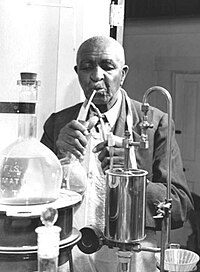
“Man cannot live by bread alone; he must have peanut butter.” What would we do without it? Dr. George Washington Carver, American scientist, botanist, educator, artist, and inventor discovered 325 products that could be made from the lowly peanut, which originally came from Africa.

Born a slave in Missouri, Carver persevered through many obstacles and became a well-educated and much admired contributor to the American way of life. His scientific discoveries dealing with plants had a significant impact on southern agriculture which continues today.

Peanuts, soybeans, and sweet potatoes were the primary objects of his study for several decades. He once said, “If you do the common things in life in an uncommon way, you will command the attention of the world.” And so, he did.

The products that he developed from the peanut included cream, buttermilk, instant coffee, face powder, printer’s ink, shampoo, dyes, soap and wood stain. Soon farmers were making more money from peanuts than they did from cotton or tobacco. It was nicknamed “goober” which came from its Congo language name, “nguba.”

Today, the uses of peanut butter itself include curing hiccups, removing gum from carpet, removing bug splatters from cars, fixing scratches on DVD’s and CD’s, removing gum from hair.

Carver’s work with sweet potatoes produced 118 products including flour, starch, tapioca, dyes, ink, and synthetic rubber. During World War I, sweet potato flour was mixed with wheat flour to make bread because wheat was in short supply.

Soybeans had been brought from China and were first planted in Georgia in 1765 and primarily used for livestock feed. Carver found through his experimentation that it was a good source of protein and oil. He told farmers to rotate peanuts, soybeans, and sweet potatoes. The result was a better cotton crop because the plants replaced essential nutrients in the soil.

Dr. Carver’s experimentation with soybeans resulted in the development of laminated plywood, particleboard, finger-jointed lumber; soy based wood adhesive, and carpet and upholstery products. Henry Ford collaborated with Carver to produce a plastic material that was then used in several parts of car manufacturing.

Currently, a process called transesterification removes the glycerin from the soybean and leaves soy biodiesel which is cleaner burning than petroleum based diesel, reduces particle emissions, is non-toxic, renewable, and environmentally friendly. Soy crayons, soy ink, soy lubricants, and soy hydraulic fluid are widely used.

Though Dr. Carver received lucrative offers from Ford and Thomas Edison, he stayed faithful to Tuskegee Institute for fifty years where he died in 1943. Congress declared January 5 as Dr. George Washington Carver Day in honor of his life achievements and contributions to society.

Dr. Carver’s impact on Albemarle agriculture is immeasurable. Today, all 100 counties of North Carolina grow soybeans, and Pasquotank is one of the top producers. Each year Elizabeth City hosts a Soybean Festival to share information about the useful plant.

(Source: Black Pioneers of Science and Invention by Louis Haber)
###

Sunday, February 10, 2013

Astrology---Science or Myth?

By: Judi Stuart
Port Discover - Visitor Services Manager

ASTROLOGY---SCIENCE OR MYTH?

What did your horoscope say today? Did you cancel a trip, avoid making a decision, or check your stock? Some people did, depending on the strength of their belief in astrology.

The National Science Foundation reports that 28% of Americans believe in the predictions of astrology, 18% are not sure, 15% read it every day or quite often, and 30% consult it just occasionally. My suspicion is that many people don't admit to checking it from time to time.

In England, 70% read their horoscopes regularly. The Chinese government has stopped their being delivered by text to reduce the load on the system. Newspapers around the world carry the horoscopes each day.

Some people actually use the predictions to govern their lives. Several presidents and their wives have been known to heed the advice of horoscopes. Mrs. Abraham Lincoln and Mrs. Ronald Reagan consulted astrologers for wisdom and decision making. Even Adolph Hitler used astrology when deciding about timing and war strategy. Some farmers believed in planting in harmony with the phases of the moon.

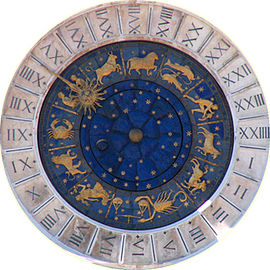
Astrology is the study of the interactions among stars and planets, and horoscopes predict their affects on humans and world events. The study of astrology can be traced back to Babylon as early as 1645 BC, and horoscopes were seen in 410 BC. The fascination with astrology spread into the cultures of Greece, Rome, Egypt, China, India, Persia, and the Islamic World. Each culture developed its own perspectives and adaptations.

Noted scientists Galileo, Copernicus, and Ptolemy created the theories that later were associated with modern concepts of the study. Astrology should not be confused with astronomy which is scientific study of heavenly bodies and the physics, chemistry, and evolution of such objects.

Over centuries, astrology has had its highs and lows in popularity. With the rise of scientific study during the Renaissance, astrology waned. Renewal of interest came after the birth of Princess Margaret of England in 1930 when newspapers printed her astrological profile. After that, most newspapers started the practice and readers were fascinated.

As time went on, other facets were added like personality traits influenced by the sign under which a person was born. Now prophecies about romance, financial success, and health are part of the picture.

Generally, astrology is not viewed as solid science but is considered by some to be a pseudoscience. While it seems to have some of the characteristics of scientific study, it does not pass the tests for being a pure science.

Though it does make observations about the natural world, it is more about predictions that cannot be measured or tested. The observations made sometimes contradict the laws of physics, and the scientific community in general is not involved with testing the validity of the theories and predictions.

Science is consistent, useful, empirically testable, based on controlled, related experiments, and progressive in nature. Reading horoscopes is better done with an understanding of their fallibility.
###
Related Posts Plugin for WordPress, Blogger...