Sunday, February 10, 2013

Astrology---Science or Myth?

By: Judi Stuart
Port Discover - Visitor Services Manager

ASTROLOGY---SCIENCE OR MYTH?

What did your horoscope say today? Did you cancel a trip, avoid making a decision, or check your stock? Some people did, depending on the strength of their belief in astrology.

The National Science Foundation reports that 28% of Americans believe in the predictions of astrology, 18% are not sure, 15% read it every day or quite often, and 30% consult it just occasionally. My suspicion is that many people don't admit to checking it from time to time.

In England, 70% read their horoscopes regularly. The Chinese government has stopped their being delivered by text to reduce the load on the system. Newspapers around the world carry the horoscopes each day.

Some people actually use the predictions to govern their lives. Several presidents and their wives have been known to heed the advice of horoscopes. Mrs. Abraham Lincoln and Mrs. Ronald Reagan consulted astrologers for wisdom and decision making. Even Adolph Hitler used astrology when deciding about timing and war strategy. Some farmers believed in planting in harmony with the phases of the moon.

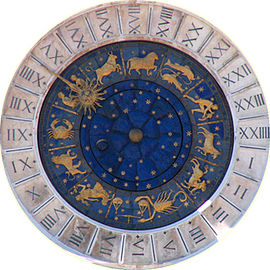
Astrology is the study of the interactions among stars and planets, and horoscopes predict their affects on humans and world events. The study of astrology can be traced back to Babylon as early as 1645 BC, and horoscopes were seen in 410 BC. The fascination with astrology spread into the cultures of Greece, Rome, Egypt, China, India, Persia, and the Islamic World. Each culture developed its own perspectives and adaptations.

Noted scientists Galileo, Copernicus, and Ptolemy created the theories that later were associated with modern concepts of the study. Astrology should not be confused with astronomy which is scientific study of heavenly bodies and the physics, chemistry, and evolution of such objects.

Over centuries, astrology has had its highs and lows in popularity. With the rise of scientific study during the Renaissance, astrology waned. Renewal of interest came after the birth of Princess Margaret of England in 1930 when newspapers printed her astrological profile. After that, most newspapers started the practice and readers were fascinated.

As time went on, other facets were added like personality traits influenced by the sign under which a person was born. Now prophecies about romance, financial success, and health are part of the picture.

Generally, astrology is not viewed as solid science but is considered by some to be a pseudoscience. While it seems to have some of the characteristics of scientific study, it does not pass the tests for being a pure science.

Though it does make observations about the natural world, it is more about predictions that cannot be measured or tested. The observations made sometimes contradict the laws of physics, and the scientific community in general is not involved with testing the validity of the theories and predictions.

Science is consistent, useful, empirically testable, based on controlled, related experiments, and progressive in nature. Reading horoscopes is better done with an understanding of their fallibility.
###

Sunday, January 27, 2013

A Wise Owl Indeed

By: Judi Stuart
Port Discover - Visitor Services Manager

A WISE OWL INDEED

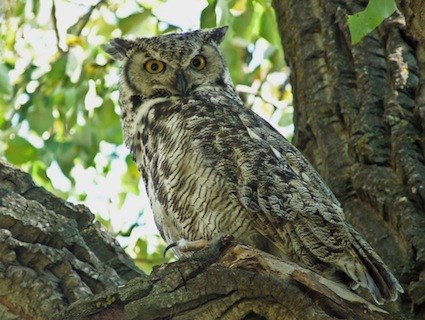
A couple of months ago, we started noticing an owl calling when we returned home in the evening. He seemed to be in the tall trees behind our house. One night, we saw him perched on the roof of our garage. When we approached him, he just sat there and stared back at us. We mentally adopted him as one of our yard pets.

Weeks later, Mr. Owl took to sitting on the vacant martin house and on other low perches in the yard. He appeared to enjoy watching us as much as we liked watching him.

Then a week ago when hubby let the dog out at night, the magnificent creature was statuesquely sitting on the gatepost about five feet from the back porch. He just sat there staring at us as we took pictures of him. His large, golden-orange eyes were studying us intently. It was one of those nature moments that you never expect to have.

Over the next few days, the owl sat on the ground, and even when we walked up to him, he didn’t move. We called an owl rescuer and a wildlife biologist to find out how to care for him. The next day he died. After examining him, the biologist said that there was no evidence of injury or any physical problem.

Great Horned Owls, also called Hoot Owls, Cat Owls, or Winged Tiger Owls, live to about fifteen years in the wild and longer in captivity. The tufts of feathers on their heads appear to be horns or ears, but they have nothing to do with hearing. Weighing about five pounds and measuring from eighteen to twenty-five inches tall, they can have a wingspan of from three to five feet.

These birds of prey perch on high places and silently swoop down on their victims which may include rabbits, mice, or on occasion even small cats or dogs. They also eat animals on the ground like snakes, fish, and frogs. One of the few animals that will eat a skunk, the owl can capture prey two or three times heavier than they are. Their binocular vision allows them to pinpoint their prey, and their heads and eyes can rotate 270 degrees.

A curious feature of the species is the owl’s stomach which contains an area in which the indigestible portions of what they eat like fur, feathers, teeth, and bones are compacted into a pellet which the owl regurgitates later. Studying this pellet can enable biologists to find out many things.

Owls are highly adaptable and live in a variety of settings in North, South, and Central America. They use the vacant nests of other birds such as hawks, crows, or herons. Mating in January and February, both the male and female take turns sitting on the nest.

We feel fortunate to have had the opportunity to observe closely this marvelous creature. We would like to think he felt like he was at home.
###

Sunday, January 13, 2013

Believe It or Not

By: Judi Stuart
Port Discover - Visitor Services Manager

BELIEVE IT OR NOT

Fred Fearing, the original Rose Buddy - Scrapbook
Elizabeth City, North Carolina
Main St - Business Section - Early 1900's
Taken from www.elizcity.com
In a publication about Elizabeth City printed in the early 1900’s, it was predicted that the thriving coastal city would become one of the largest, most progressive towns in North Carolina by the year 1915.

Based on the number of successful businesses, rate of construction, number of boats licensed to do business on the river, the number of farming, fishing, and lumber businesses, the future success of the town was a sure thing.

Events happen, things change, and predictions fail.

The dawning of the new year always prompts people to make predictions about many areas of life such as business, the economy, the stock market, sports, politics, natural disasters, pandemics, scientific discovery, weather, and many others.

Author Sean Covey shares the “Top 10 Stupid Quotes of All Time” which includes the following predictions:
  • “Everything that can be invented has been invented.”-C.H. Duell, US Commaner of Patients in 1899.
  • “The earth is the center of the Universe.”-Ptolemy, Egyptian Astronomer in the second century.
  • “Man will never reach the moon, regardless of all the future scientific advances.”- Dr. Lee DeForest, inventor and Father of Radio, 1967.
  • “Television won’t be able to hold on to any market it captures after the first six months. People will soon get tired of staring at the plywood box every night.” -Darryl Zanuck, Head of 20th Century Fox in 1946.

People have always had a compulsion to know the future. For centuries, Greeks consulted the Oracle at Delphi, an old woman who lived in a cave and was believed to have the power to see into the future. Ben Franklin created his Poor Richard’s Almanac which put forth predictions about weather and other bits of useful wisdom.

Other famous predictors from many areas of thought include Nostradamus, Leonardo Da Vinci, H.G. Wells, Isaac Asimov, and Alvin Toffler. Most non-scientific seers of the future use their powers of observation, past experiences, and individual knowledge to project what the future holds.

Making predictions is part of all scientific experimentation. Even young students working on their science fair projects must predict, form a hypothesis, collect data, test their ideas, and come to a conclusion.

American statistician and author Nate Silver has garnered much attention for his work in several fields of prediction. As a sabermetrician, an analyzer who uses baseball statistics to make predictions, he gained world recognition for his amazing accuracy. In the area of politics, his ability as a psephologist was demonstrated when he correctly predicted the outcomes in both the 2008 and 2012 presidential elections.

Using polls, finance information, and voting data, Silver was correct in 49 of 50 states in his pre-election analysis. His book, The Signal and the Noise-Why So Many Predictions Fail-But Some Don’t, was named Amazon’s number one non-fiction book for 2012. Silver’s methods have changed the science of prediction.

Some predictions might be called prophecy, but others are the result of careful scientific and mathematical study and calculation.
###
Related Posts Plugin for WordPress, Blogger...