Sunday, December 16, 2012

Spirits Everywhere

By: Judi Stuart
Port Discover - Visitor Services Manager

SPIRITS EVERYWHERE

Mannheim Steamroller has created my favorite versions of Christmas music for the last twenty-five years. I always get some growling from Hubby when he gets his fill of it during the holidays. A couple of years ago he changed his tune when he heard Mannheim’s “Up Above the Northern Lights on Christmas Night.”

The piece is a hauntingly dramatic musical reflection of the astronomical phenomenon scientifically known as the aurora borealis (northern) or aurora australis (southern) which usually occurs near the two poles of the earth. One of his bucket list goals is to go to see the lights in all their glory.

Proclaiming that “magic fills the air” and “spirits are everywhere” the lyrics get in your mind and won’t leave you. You can see it and hear it on www.youtube.com with a video (see below) of the scientific wonder in action.

The lights have been observed since ancient times, but the earliest account is from Babylonian clay tablets during the time of King Nebuchadnezzar II in approximately 568 B.C.

The dancing curtains of magical colors have fascinated humans for thousands of years. Aristotle called them light torches, and Europeans of the Middle Ages thought that they were flaming heavenly castles or armies of warriors who had died in battle.

Children of Norway believed that the lights would swoop them up into the sky if they waved a napkin at them. Eskimos thought that the aurora was dancing animal spirits of deer, seals, and salmon. Inuit tribes thought that the spirits of the dead were playing football with a walrus skull across the sky.

Named after the Roman goddess of dawn, Aurora, and Boreas, the Greek name for north wind, the Northern Lights can appear as patches of light, streamers, arcs, or rays painted in colors of green, blue, violet, red, and yellow. On rare occasions, when solar storms are extremely violent, the lights can be seen much further south or north than the poles.

Solar winds from sun storms send charged particles to earth in the form of clouds of gas. Earth has a protective shield called the magnetosphere. When the particles collide with the magnetic field, they cause changes and generate currents which flow along the lines of magnetic force into the Polar region. When they run into oxygen and nitrogen atoms, they produce the dazzling aurora lights.

Auroras tend to be more spectacular during periods of high solar activity which cycles every eleven years. The activity has been known to damage our electrical power grid and satellite operations. The National Aeronautics and Space Administration (NASA) has sent satellites on several missions called FAST, POLAR, and IMAGE to observe the activity of the Northern Lights.
The best places to see the northern lights are closer to the poles such as Canada, Alaska, Greenland, and Antarctica. They happen all the time, but can only be seen with the naked eye at night.

As the song proclaims, “Christmas night...Let your dreams take flight.”
###

Sunday, December 2, 2012

A Season of Senses

By: Judi Stuart
Port Discover - Visitor Services Manager

A Season of Senses

Without silver bells, pumpkin pie, colored lights, snowflakes, candlelight, carols, children’s smiles, and other favorite things, the holidays just wouldn’t be the same. Humans are sensory focused creatures.

We have now entered the winter wonderland of sensory awareness. With its unique collection of experiences that delight our senses, the Christmas season can enhance the enjoyment of stimuli like no other during the year.

So much of our pleasure in life as human beings comes by way of our senses of touch, taste, smell, hearing, and seeing. Each holiday during the year has its own special set of foods, songs, scents, colors, and textures for us to experience. Every culture around the world has its own unique celebrations with their special sensory experiences.

Our senses bring us pleasure and sometimes pain. They are our radar for the world around us and give us impressions that affect our mood and our interaction with our surroundings. Each one of us has smells, sounds, sights, textures, and tastes that connect us to our own Christmas memories.

My father’s favorite carol was the “Little Drummer Boy” so the sound of that makes me think of him. My sister and I always got a new doll from Santa when we were young, and even now I can clearly remember the smell of the vinyl as I went to sleep. My own children say that it’s not Christmas without the smell of the sausage and egg casserole waking them up.

Spreading glistening, white angel hair all over the tree was my task as a child. Since it was made of fiberglass, the pain of it and the redness of my hands lasted for a couple of days. That’s not a good memory. Who can ever forget the story of “The Little Match Girl” and its tragic descriptive ending?

If you want to increase your enjoyment this season, try some techniques to focus your senses. Take the time to breathe deeply and notice all of the specials scents around you whether they’re food or the cold, crisp air of the outdoors. Stare at the night sky and notice the brightness of the stars and the moon. Enjoy the light displays all over the city. Listen to holiday music and try to hear the softer sounds. Find a new holiday food and learn its history and how to prepare it.

Act like a kid and touch everything. Think of all the descriptive words that are unique at Christmas. Most of all, encourage your children to do all of these things with you.

Take a long walk on a dirt road and maximize the use of your senses. Notice the small things in your world. Slow down. None of your senses work their best when you rush.

Many of the things that bring us the most pleasure during the holidays don’t cost a thing. If you focus on your sensory awareness this season, you will come closer to experiencing the real meaning of Christmas-love.
###

Sunday, November 18, 2012

Let’s Talk Turkey

By: Judi Stuart
Port Discover - Visitor Services Manager

Let’s Talk Turkey

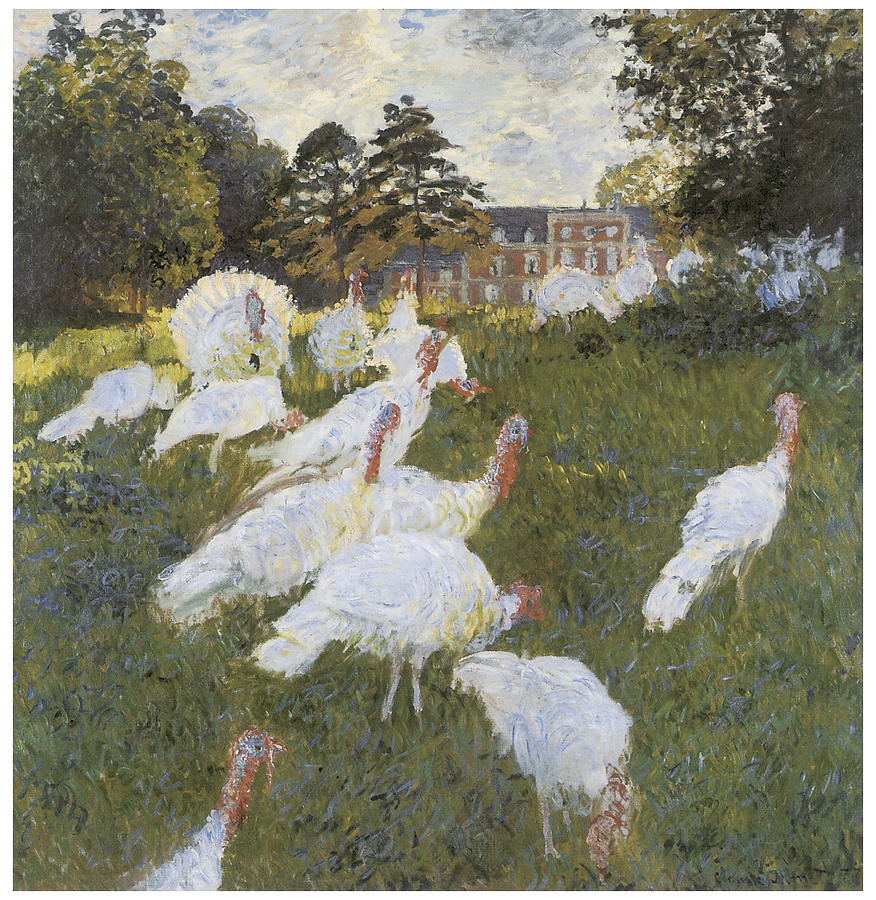
Turkeys Painting by Claude Monet
Perhaps no other bird has been given so much respect and disrespect as the Meleagris gallopavo or wild turkey. Benjamin Franklin called him a “bird of courage” and French impressionist Claude Monet painted him in a landscape in 1876. If someone calls you a “turkey,” it’s not a compliment. Since this famed character will be the center of attention in most of our homes next week, I think he deserves some understanding.

The species was well known to the Native Americans and the Aztecs long before the explorers of the New World discovered them. They were so desired by the Spanish explorers that their king ordered that each ship must bring some of the birds home with return voyages.

Mayans used turkey parts in religious ceremonies praying for rain or asking for healing or a good harvest. Native Americans believed that shamans could turn themselves into turkeys and then prowl around enemy villages without being recognized.
The European settlers replaced the boar and the goose with the turkey for festive meals and thus made it the legendary center of the Thanksgiving feast. The official day for the holiday was set by Franklin D. Roosevelt in 1939, although it had been unofficially celebrated for years.

With a wingspan of about six feet, wild turkeys can fly at 55 miles per hour and run at 25 miles per hour, but their modern domesticated cousins can’t fly at all because they have been bread to weigh twice as much. In the wild, turkeys like to sleep in trees and specifically prefer oak trees. Scientists have found that they have twenty distinct vocalizations which are recognized by other turkeys.

Some people have proclaimed that turkeys are so stupid that they will stare up at rain until they drown. Researcher Tom Savaged studied the phenomenon and discovered that they can have a genetic condition which causes them to cock their heads and look into the sky for 30 seconds or more which may have led to the misunderstanding of the animal’s behavior. They have also been observed to have certain social interactions which indicate intelligence.

Wild turkeys forage for acorns, insects, seeds, roots and wild berries to eat. Early settlers found that the birds liked to live near humans and were friendly and trusting and would walk right up to them and even seemed affectionate. A male can weigh up to 38 pounds and is called a Tom turkey or a gobbler.

Although they have no ears, turkeys still have a keen sense of hearing. Hunters can testify that their peripheral vision is astounding because with a turn of their head, they can see 270 degrees and sense movement a hundred yards away. They have a poor sense of smell but do have an excellent sense of taste.

Like many animals that are raised for food, the domestic turkey is mistreated and misunderstood. I think I’ll be a little more thankful for my bird this year.
###
Related Posts Plugin for WordPress, Blogger...