Monday, March 12, 2012

Walking with a Purpose

By: Judi Stuart
Port Discover - Visitor Services Manager

Walking with a Purpose

Walking is my preferred type of exercise. In fact, jumping around and sweating is not my style at all. I definitely need motivation, and Port Discover is providing that for all of us.

“Worth the Walk” is the latest community program designed by Port Discover and supported by the Albemarle Hospital Foundation in collaboration with Vidant Health through their Community Benefit Grants Program.

The objective is for individuals, or community group teams, to get out and get walking! To register, go to the “Worth the Walk” link at www.portdiscover.org. Port Discover, through an on-line program, will record steps taken by members, with an overall to see how far across the country, or even the world, citizens will walk. A map posted in the Port Discover window will be regularly updated to show the community’s progress.

Walking maps of the Elizabeth City historic districts, provided in part by the Elizabeth City Historic Neighborhood Association, can be found on the Worth the Walk page at www.portdiscover.org. The maps include supplemental activities and exercises that can be done along the way.

We all know that walking is good for us, but how, specifically? In searching for the answer, I found www.rodale.com, the site for Rodale News, “where health meets green.” The organization is the publisher of Prevention Magazine and many other science and health publications. An early pioneer in promoting organic farming, J. I. Rodale’s family has carried on the traditions and promotes all things healthy.

Leah Zerbe in her article, “8 Astonishing Benefits of Walking” says that the activity often helps insulin resistant people from developing type 2 diabetes. Besides helping to bring desire and satisfaction to your love life, it can help to reduce your need for some medications.

Another way walking might save you money. Exploring the great outdoors and discovering the rich history of downtown Elizabeth City are free, and your outlook on life might also improve from the exposure to the beauty of nature and the stories of our community’s past.

Much focus has been placed on the need to walk 10,000 steps per day. Studies have shown that fibromyalgia pain can be reduced by walking and stretching. Mental capacity, energy, and depression can also be increased by exercise.

Women who walked the year before being diagnosed with breast cancer have been found to be 30% more likely to survive the disease. Those who walked after being diagnosed had a 45% greater chance of surviving according to a study published in the Journal of Clinical Oncology.

Walking when done 30 minutes per day for 5 days per week has been found to lower the risk of stroke. Vigorous walking and the increased flow of blood to the brain have been found to produce a 27% lower risk of dementia.

All of those benefits are impressive, extremely motivating, and definitely worth the walk. Come join us! Bring your family!
###

Check out these links:
Elizabeth City's Self-guided Historic Walking Tour : National Historical Districts
Pasquotank County's Neighborhood Walking Mileage
Dismal Swamp State Park
Dismal Swamp Trails

Monday, February 27, 2012

Nature’s Sanitary Workers

By: Judi Stuart
Port Discover - Visitor Services Manager

Nature’s Sanitary Workers

When my work at Port Discover expanded to include writing this column a year ago, I had no clue how it would alter my vision of the world. In order to find subjects to explore and write about, I had to adjust my focus to include the science topics that I encounter and observe daily. Things I used to ignore have become food for investigation.

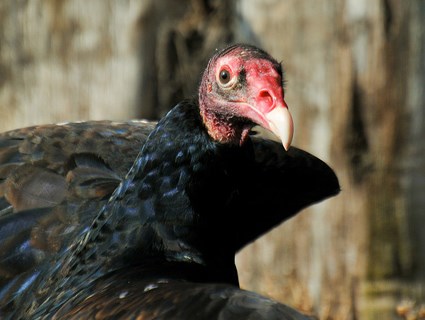
Today, for your Sunday morning edification, my topic is turkey vultures. The woods next to our house now host approximately fifty of the carrion-eating carnivores every evening. Why? I haven’t discovered that yet.

One Sunday morning recently, I heard and saw my neighbor across the canal standing on her back porch in her bathrobe loudly beating on a pan with a spoon in an effort to scare the birds away. Two weeks after that, I was standing on my back porch ringing a large antique cowbell trying to accomplish the same.

I’m sure the vultures were laughing, and they weren’t scared a bit by either one of us. There is just something unnerving about the way they sit in the trees silently looking down. You begin to wonder what they are waiting for. Because they have no voice box, the only sound they make is the slight flapping of their wings as they settle down for the night in the trees.

There is a Turkey Vulture Society whose site has many interesting facts about the helpful scavengers. Also, Cornell University has done much research on the birds and other species, which you can find on their site.

The Migratory Bird Treaty Act of 1918 protects these year round residents of our area, and it is against the law to shoot one. They are raptors, and serve mankind through their habit of eating dead animals.

Although television westerns used to portray them as evil, some religious groups such as Tibetan Buddhists honor them, and depend on them for the removal of their dead. They believe that vultures release the soul from the body.

Often incorrectly called buzzards, they are unaggressive and non-confrontational, and unlike their cousins the black vulture, they do not kill. Often feeding on road kill, washed up fish, as well as rotten pumpkins, and juniper berries, they politely take turns eating. They can soar gracefully for hours using thermals of warm rising air for lift.

It is some of their other characteristics that are not too appetizing. Readers with weak stomachs might want to stop here.

Their heads are almost bald which allows them to eat without getting remains on them. Frequently, they urinate on themselves, not only for cooling, but also to kill the harmful bacteria that are on their feet. If they are scared or threatened, they vomit in order to ward off the enemy with the smell.

I trust that they will move on eventually. In the mean time, I’m considering becoming a vegetarian.
###

Tuesday, February 14, 2012

Talking (Less) Trash

By: Judi Stuart
Port Discover - Visitor Services Manager

Talking (Less) Trash

Difficult times changes people’s values. Looking back at history, you find that major events usually refocus the way that we see our world. I hope that one of the results of the Great Recession is that we learn to value experiences and people, instead of things.

The material excesses of the American way of life are overdue for an examination and overhaul. Bea and Scott Johnson and their two sons of Mill Valley, California are setting an example for all of us. Their effort to reduce their household trash to zero was featured in People Magazine recently.

According to the article, the average American produces 1,051 pounds of trash per year. Even with all the talk of creating an eco-friendly world, experts know that our habits are not sustainable and that we must change.

Ms. Johnson suggests specific techniques for eliminating trash on her website, www.thezerowastehome.com. The ideas presented are extremely useful and focus on the four R’s—refuse, reduce, reuse, and recycle.

The concept of refusing was new to me. When the Johnsons purchase something that is wrapped in too much packaging, they unwrap it and leave the trash at the store. The message to the manufacturer is to use less packaging. They also buy things in bulk and take their own reusable containers to stores.

A great deal of planning goes into every aspect of life when the goal is to reduce our carbon footprints. Most of us find it difficult to spend time making the effort, no matter how much we want to behave responsibly toward our environment. We tend to take the easy way out and continue to live our disposable way of life.

The Johnsons recommend buying used items. For the last three Christmases, my adult children have engaged in an activity they call “Craigsmus.” They draw names among the six of them and try to find a useful gift on Craigslist for a limited amount of money. The results have been hilarious, creative, useful, and memorable for the whole family, but also rewarding in many ways.

A key technique is to organize your possessions, so that you know what you have and won’t buy things you already own. We all waste a lot of food because it goes out of date before we can use it, or it gets lost in the back of the pantry.

The Johnsons reduced their actual trash to a large mason jar full in a year’s time. That’s extreme, but we can all make an effort to consume intelligently. Doing something is better than nothing. You can make some small adjustments and, as the Johnsons report, be “happier, healthier, and richer.”

Margaret Mead, American Cultural Anthropologist, said, “Never doubt that a small group of thoughtful, committed citizens can change the world; indeed, it’s the only thing that ever has.” She’s right.
###


Check out this video from the The Huffington Post:

Visit msnbc.com for breaking news, world news, and news about the economy

Related Posts Plugin for WordPress, Blogger...